
Extreme Long Range Rifles: How to Shoot Beyond One Mile
Jeremy Walberg Jun 25, 2026
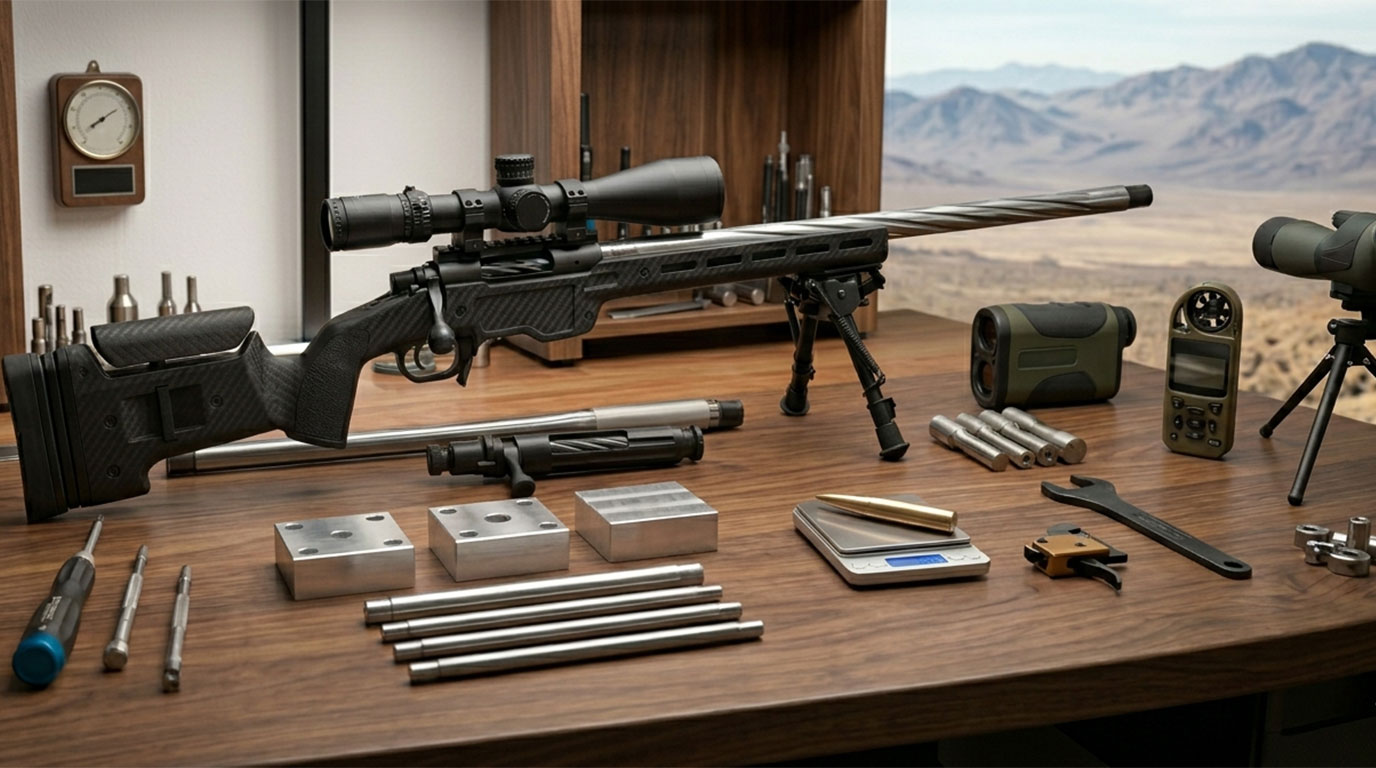
Extreme Long Range Rifles: How to Shoot Beyond One Mile
Meta description: ELR shooting past 1,760 yards demands a purpose-built rifle, a high-BC bullet, a scope with serious elevation, and the skill to read wind that changes block by block.
Extreme Long Range starts where most precision shooting ends. A mile is 1,760 yards, and at that distance a 6.5 Creedmoor has been in flight for around 3 seconds, dropped roughly 80 feet, and drifted multiple feet sideways for every 1 mph of crosswind. To put a bullet on a man-sized target at that distance reliably, every part of the system has to be built and tuned for it — the rifle, the cartridge, the optic, and the shooter.
What “ELR” actually means
The shooting community defines ELR loosely as engagements beyond 1,500 yards, with formal competitions like King of 2 Miles, NRL ELR, and Applied Ballistics ELR pushing into 2,000–4,000+ yard territory. At those distances, ballistic calculation isn’t a guideline — it’s the only thing standing between you and missing by 20 feet.
The cartridges that dominate ELR aren’t the same ones that dominate PRS. Common ELR chamberings:
- .338 Lapua Magnum — entry point for serious ELR, manageable recoil, factory ammo available
- .375 CheyTac and .408 CheyTac — purpose-built ELR cartridges
- .416 Barrett, .50 BMG — heavy bullets, high BC, intended for the 1.5- to 2-mile range
- Wildcats — .375 Snipetac, 33XC, 7mm Practical, and other purpose-built rounds run by competitive ELR shooters
The common thread: high ballistic coefficient bullets (G7 BC 0.300+) launched at velocities that keep them supersonic well past one mile.
The rifle
A serious ELR rifle is a precision platform built around heavy machining and tight tolerances:
- Long action sized for the cartridge (.338 Lapua and up requires magnum-length actions)
- Barrel of 26“–32” length, heavy contour, from a top-tier maker (Bartlein, Krieger, Hawk Hill, Brux, Proof for the lighter cartridges)
- Receiver blueprinting or a true custom action to ensure the barrel-to-action interface is square and the bolt face is true
- Chassis — Cadex, MDT, MPA, Accuracy International — purpose-built ELR chassis with full adjustment, length, and accessory mounting
- Muzzle brake — at .338 and up, recoil management isn’t optional; a quality brake lets you spot your own shots through the scope
Expect a finished rifle weight of 18–30+ lbs. ELR is not run-and-gun.
The optic
Standard precision scopes don’t have enough elevation travel to dial a mile of drop. ELR-grade optics need:
- Total elevation travel of 100+ MOA or 30+ Mils
- Repeatable, tracked adjustments that return to zero
- Reticle clarity at high magnification
- High elevation turret — not standard zero-stop tactical turrets
Common choices: Nightforce ATACR 7-35x with high-rise turret, Schmidt & Bender PM II 5-25x or 12-50x, Tangent Theta TT525P. Mounted on a 40- or 60-MOA rail or a canted scope mount, often with an additional 20-MOA picatinny adapter to add elevation if needed.
Ammunition
Factory match ammo runs out of headroom past 1,500 yards. Most ELR shooters handload, optimizing each load for:
- Bullet selection — high-BC monometal or hybrid bullets (Berger Hybrid, Hornady A-Tip, Cutting Edge MTH)
- Velocity consistency — single-digit standard deviations measured over a chronograph
- Brass uniformity — sorted, weighed, annealed, neck-turned
A 10 fps SD on a 2,800 fps load translates to roughly 6" of vertical dispersion at one mile from velocity variance alone. Consistency in the load is non-negotiable.
Reading the environment
Past one mile, the bullet flies through air that changes from yard to yard. You need to account for:
- Wind speed and direction at multiple points along the trajectory — wind at the muzzle, mid-trajectory, and the target are often different
- Air density — temperature, altitude, humidity, barometric pressure
- Spin drift — the bullet drifts sideways from rifling-induced rotation; meaningful past 1,000 yards
- Coriolis effect — earth’s rotation deflects the bullet; meaningful past 1,500 yards depending on latitude and direction of fire
A ballistic calculator (Hornady 4DOF, Applied Ballistics, Strelok Pro) and an environmental sensor (Kestrel 5700 Elite with AB) replace the cardboard ballistic chart you might use at 600 yards. ELR competitive shooters run these as standard equipment.
The skill side
Equipment puts the bullet in flight. The shooter puts it on target. Skills that matter:
- Reading wind by mirage, vegetation movement, and downrange terrain at multiple points
- Spotting impact through the scope and making correction calls in real time (the brake and the heavy chassis are what make this possible)
- Building a stable position at long range — bipod, rear bag, level the rifle, settle the natural point of aim
- Trigger discipline that’s repeatable across multiple seconds of hold
ELR shooting is taught in dedicated schools — K&M Precision Rifle Training, Magpul Precision Rifle, Mile High Shooting Accessories — and it pays to take a course before you sink five figures into the rig.
What a build like this costs
A purpose-built ELR rifle, optic mounted, ready to shoot:
- Rifle alone: $5,000–$10,000+ depending on action and chassis
- Optic and rings: $2,500–$5,000+
- Brake or suppressor: $300–$2,000+
- Ammo for development: $500–$1,500 for an initial load workup
- Environmental sensor + ballistic software: $400–$700
Total entry into competitive ELR is typically $10,000–$15,000 for a serious setup, more if you want the best of every component.
Get the rifle right first
Past 1,500 yards, the rifle is the floor of what’s possible. A mediocre rifle will limit you no matter how good the rest of the system is. Spend the time to spec the right action, the right barrel from the right maker, properly chambered and fitted, with a chassis and optic that match the application.
If you’re stepping into ELR, start the conversation with a gunsmith who’s built ELR rigs before. The component decisions and the machining quality compound — get them right at build time and the rifle will shoot to the limits of your skill, ammo, and the wind.
Related services
- Receiver blueprinting for actions that aren’t custom from the start
- Barrel chambering in ELR cartridges with proper headspace
- Muzzle threading for brake or suppressor mounting

Information